Quick Answer:
-
Canadian tax residents generally need Form T1135 when the total cost of specified foreign property exceeds CAD 100,000 at any time during the year.
-
CRA uses cost amount, generally the adjusted cost base, rather than current market value for the CAD 100,000 test.
-
Qualifying personal-use foreign property can be excluded from T1135 reporting.
-
Foreign rental income can still require Canadian tax reporting even when Form T1135 is not required.
-
Dubai investment property can count as specified foreign property, while off-plan purchases require careful review of when ownership is actually acquired.
Do you have to declare foreign property in Canada? For Canadian tax residents, the answer usually depends on the total cost of their specified foreign property, how they use it, and whether they cross the CAD 100,000 Form T1135 threshold. CRA tests the combined cost of reportable foreign assets rather than looking at one property in isolation.
The CAD 100,000 figure is not a tax-free allowance. It determines whether additional foreign-property reporting may apply, while foreign income can still need Canadian tax reporting below that amount. The CRA T1135 guidance explains the difference between the reporting threshold and income-reporting obligations.
This guide explains the current CRA foreign property rules, including the T1135 threshold, personal-use property, rental income, mortgages, Canadian tax residency and Dubai real estate. It also explains how CRA treats new Canadian residents and off-plan foreign property. This guide provides general information and does not replace advice from a qualified Canadian tax professional.
Do You Have to Declare Foreign Property in Canada?
A Canadian tax resident generally needs to consider Form T1135 if the total cost amount of specified foreign property exceeds CAD 100,000 at any time during the year. The threshold applies to the combined cost of reportable foreign property, not simply to one asset. CRA's Foreign Income Verification Statement guidance sets out the current reporting framework.
Canadian tax residency matters more than citizenship alone. CRA states that income-tax obligations depend on residency status, and only taxpayers resident in Canada have a T1135 filing obligation. Canadians who move to Dubai should therefore establish their Canadian tax-residency position before assuming the same reporting rules still apply.
Do You Have to Declare Foreign Property in Canada Every Year?
You need to assess the rule for each tax year. If your specified foreign property exceeds the CAD 100,000 cost threshold at any point during a year, selling assets before December 31 does not automatically remove the filing requirement.
CRA specifically states that taxpayers who exceeded the threshold during the year still need to consider all specified foreign property held during that year. The test therefore looks beyond what you own on the final day of the year.
Understand the $100,000 Rule
CRA bases the CAD 100,000 threshold on cost amount, which generally means the property's adjusted cost base. The test does not use today's market value. This distinction matters when a foreign property rises or falls significantly in value after purchase.
The threshold also combines different specified foreign assets. For example, CRA gives a case involving CAD 75,000 in foreign shares and CAD 35,000 in a foreign bank account. Neither asset exceeds CAD 100,000 alone, but their combined cost reaches CAD 110,000 and crosses the reporting threshold.
Table 1: T1135 Threshold at a Glance
|
Foreign Property Position |
General Reporting Treatment |
|
CAD 100,000 or less |
T1135 generally not required |
|
More than CAD 100,000 but less than CAD 250,000 throughout the year |
Part A simplified reporting may apply |
|
CAD 250,000 or more at any time |
Part B detailed reporting generally applies |
|
Qualifying personal-use property |
May be excluded from T1135 |
|
Foreign property producing income |
Income can still require Canadian tax reporting |
The CRA Part A and Part B guidance confirms that Part A can apply when the total cost stays below CAD 250,000 throughout the year. If the total reaches CAD 250,000 or more at any point, detailed Part B reporting generally applies.
What Counts as Foreign Property?
Specified foreign property can include foreign investment real estate, money held outside Canada, shares of non-resident corporations and certain other foreign interests. CRA excludes qualifying personal-use property from specified foreign property. CRA also provides exclusions from Form T1135 reporting for certain foreign property held through registered plans such as RRSPs and TFSAs.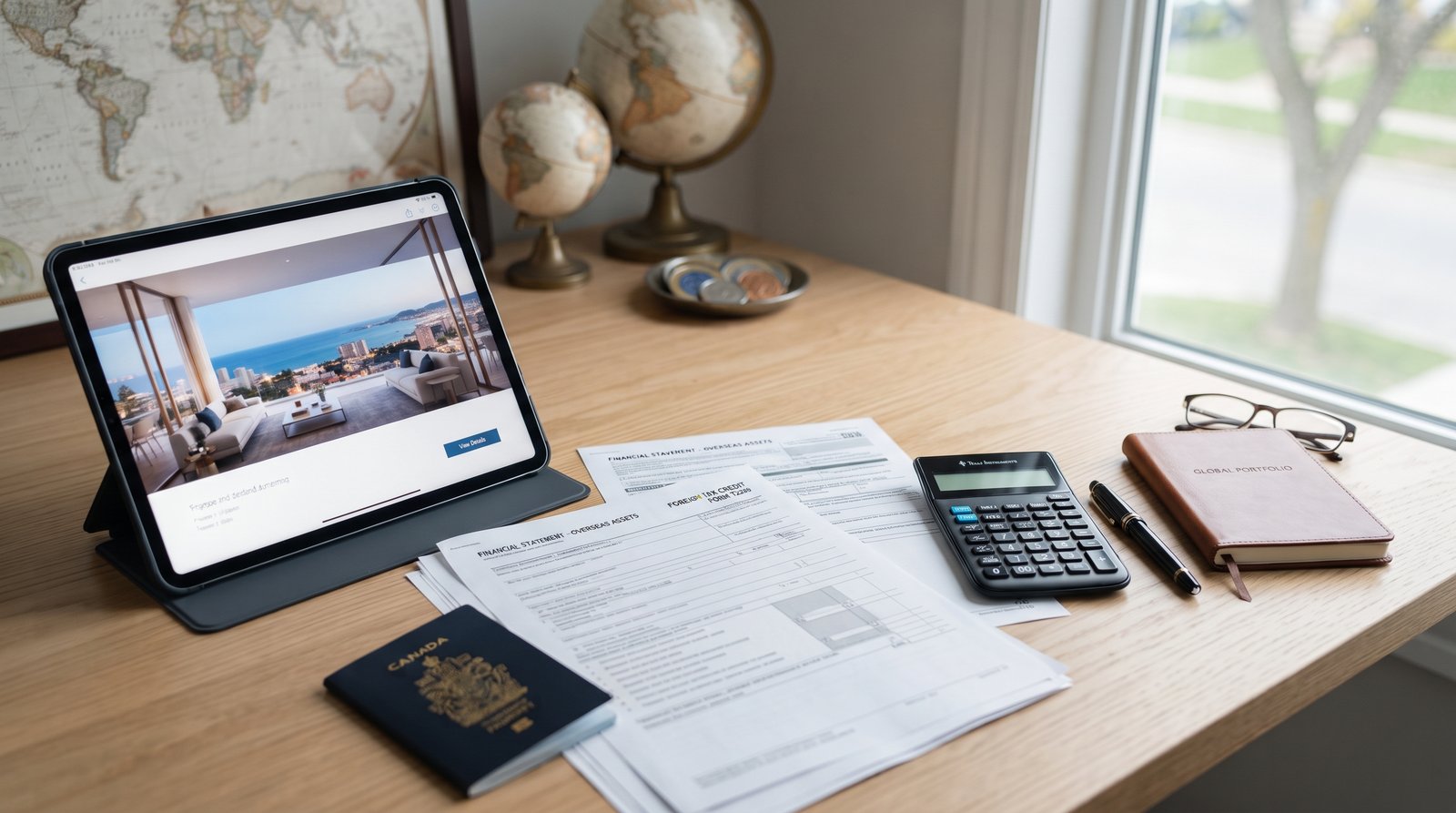
Dubai investment property can fall within T1135 foreign property reporting when it meets the definition, and the taxpayer crosses the reporting threshold. Canadians who are still researching ownership can also review Can Canadians Buy Property in Dubai? for the separate UAE purchase process.
Property That May Need Review
-
Dubai apartments or villas held to earn rent
-
Foreign property held primarily as an investment
-
Foreign bank accounts and certain foreign securities
-
Several foreign assets whose combined cost exceeds CAD 100,000
-
Mixed-use property that combines personal and rental use
-
Contractual interests where ownership or acquisition timing is unclear
The facts matter. Complex ownership through companies, partnerships, trusts or contractual arrangements can require professional tax advice.
Personal-Use Property Exemption
CRA excludes qualifying personal-use foreign property from Form T1135. A foreign vacation home used mainly for personal enjoyment can therefore fall outside the reporting requirement even when its cost exceeds CAD 100,000.
CRA generally interprets “primarily” as more than 50% personal use or enjoyment. However, CRA decides the treatment based on the actual facts rather than the property's label.
Mixed Personal and Rental Use
Consider a Dubai apartment used personally for part of the year and rented during the rest. CRA gives an example where a foreign condominium is rented for eight months with a reasonable expectation of profit and used personally for four months. CRA treats that property as specified foreign property because personal use does not exceed 50%.
CRA reaches a different result where an owner rents property temporarily without a reasonable expectation of profit and only recovers part of the expenses. In that situation, CRA may still treat it as personal-use foreign property.
Table 2: Dubai Property Examples
|
Dubai Property Situation |
General T1135 Consideration |
|
Vacation home used mainly personally |
May qualify for personal-use exclusion |
|
Apartment rented for profit |
Can be specified foreign property |
|
Property partly rented and partly used personally |
Depends on primary use and facts |
|
Several foreign assets over CAD 100,000 combined |
Threshold may be crossed |
|
Mortgaged investment property |
Mortgage does not reduce cost to equity |
|
Off-plan property under construction |
Acquisition timing and contract terms matter |
These examples illustrate general CRA principles. They do not determine the tax position of every property owner.
Does a Mortgage Reduce the Threshold?
No. CRA uses the property's cost amount, a defined tax concept that is generally based on adjusted cost base. Mortgage financing does not simply reduce that cost amount to the buyer's cash or equity contribution.
CRA gives an example of foreign property costing CAD 500,000 with only a CAD 50,000 down payment. The buyer still crosses the CAD 100,000 threshold because the property costs CAD 500,000.
For example, assume a Dubai investment property costs the equivalent of CAD 400,000. You contribute CAD 100,000 and finance CAD 300,000. You should not treat your T1135 foreign property cost as only CAD 100,000 simply because that represents your equity contribution.
Foreign Rental Income Rules
Form T1135 and Canadian income-tax reporting perform different jobs. Form T1135 can require taxpayers to report the gross income earned from specified foreign property, while the Canadian income-tax return separately reports rental income and eligible expenses. Canadian tax residents may therefore have foreign-income reporting obligations even when the CAD 100,000 T1135 threshold is not exceeded.
The T1135 threshold determines whether an additional information form is required. It does not create an exemption from Canadian tax reporting for foreign rental income.
Rental property owners use Form T776, Statement of Real Estate Rentals to report rental income and expenses for income-tax purposes. CRA's current Form T776 guidance confirms that rental property owners use the form to calculate rental income and expenses.
For a wider discussion of UAE ownership and Canadian taxation, read the site's Dubai Property Tax for Canadians guide. That article covers broader taxation, while this page focuses on foreign-property declaration and T1135 reporting.
Table 3: T1135 vs Rental Income Reporting
|
Form T1135 |
Rental Income Reporting |
|
Information-reporting requirement |
Income-tax reporting obligation |
|
Focuses on specified foreign property |
Focuses on rental income and expenses |
|
CAD 100,000 threshold matters |
Income can still be reportable below the threshold |
|
Does not calculate rental profit |
Rental reporting calculates income and expenses |
|
Uses Part A or Part B where applicable |
Property owners generally use Form T776 |
Keeping the two requirements separate prevents a common mistake. Filing one does not automatically satisfy the other.
Part A vs Part B
CRA uses two T1135 reporting methods. Part A offers simplified reporting when the total cost of specified foreign property is more than CAD 100,000 but less than CAD 250,000 throughout the year.
Part B generally applies if total cost reaches CAD 250,000 or more at any time during the year. CRA allows a taxpayer who qualifies for Part A to choose detailed Part B instead, but the taxpayer should not complete both methods for the same filing. The current Form T1135 page provides the official form and filing materials.
Off-Plan Dubai Property
Off-plan Dubai property needs careful treatment because signing a purchase agreement or making the first deposit does not automatically settle the T1135 question. CRA gives a specific example involving foreign real property that will be built and completed later.
CRA says the purchase agreement must be examined to determine when the taxpayer actually acquires the property or relevant interest. In CRA's specific example, title had not passed and the real property was not yet reportable. However, title transfer should not be treated as the only test for every off-plan contract.
Check Acquisition Timing
This makes contract terms important for Canadians purchasing off-plan Dubai property. Buyers should review:
-
whether title has transferred
-
what rights the purchase contract creates
-
whether construction remains incomplete
-
how staged payments work
-
whether assignment rights exist
-
whether another entity holds the property
Do not assume every first deposit creates an immediate T1135 obligation. A Canadian tax professional can review the contract when acquisition timing is unclear.
Canadian Residency Matters
Canadian income-tax obligations depend on residency status rather than citizenship alone. The CRA residency guidance says taxpayers need to consider all relevant facts, including residential ties, the purpose of their stay and the continuity of living inside or outside Canada.
Significant Canadian residential ties can include a home, spouse or common-law partner and dependants in Canada. Other ties can also matter. Moving to Dubai therefore does not automatically make someone a non-resident for Canadian tax purposes.
Canadians planning a wider relocation can read How to Move to Dubai From Canada for immigration, housing and relocation planning. Tax residency should still be considered separately.
New Residents of Canada
CRA provides a special rule for individuals who first become Canadian residents. An individual does not file Form T1135 for the tax year in which they first become resident in Canada.
For later T1135 reporting years, CRA generally uses the property's fair market value when the individual became a Canadian resident as its cost amount for T1135 purposes. This rule can matter for someone who already owned Dubai property before moving to Canada.
The rule applies specifically to the individual's first year of Canadian residency. It should not be confused with the normal cost rules for property acquired after becoming a Canadian resident.
Before Filing Form T1135
Start by collecting the information that determines whether the reporting requirement applies. Good records also make it easier to explain acquisition dates, costs and property use if questions arise later.
Information to Check
-
Canadian tax-residency status
-
Total cost of specified foreign property
-
Acquisition and disposal dates
-
Whether the property was rented for profit
-
Personal-use periods
-
Foreign rental income
-
Whether the CAD 100,000 or CAD 250,000 thresholds were crossed
-
Purchase contracts, title documents and payment records
Form T1135 is generally due on the taxpayer's normal income-tax filing deadline. Use the current CRA form and filing instructions rather than relying on an older downloaded copy.
What If You Sold During the Year?
Selling a foreign property before year-end does not automatically remove the T1135 obligation. CRA looks at whether total specified foreign property exceeded CAD 100,000 at any time during the year.
If the threshold was crossed, the taxpayer must still consider specified foreign property held earlier in that year. Keeping acquisition and sale records makes this easier to establish.
This distinction matters for investors who sell a Dubai property and assume they no longer have a reporting issue because they hold no foreign real estate on December 31.
What Canadian Dubai Investors Should Do
The safest approach is to separate the Canadian tax question from Dubai's local property rules. Dubai ownership may create a foreign asset for a Canadian tax resident even though the UAE and Canada apply different tax systems.
Dubai Investor Checklist
-
Confirm your Canadian tax-residency status.
-
Calculate the combined cost of specified foreign property.
-
Separate investment use from qualifying personal use.
-
Do not reduce cost to your mortgage equity.
-
Report foreign rental income separately when required.
-
Review off-plan acquisition timing carefully.
-
Keep purchase, title, rental, and payment records.
-
Get Canadian tax advice for complex ownership structures.
This process gives a more reliable answer to whether you have to declare foreign property in Canada than relying on the CAD 100,000 figure alone.
Planning a Dubai Property Purchase?
If you are researching do you have to declare foreign property in Canada before purchasing in Dubai, reviewing the Canadian rules early can make recordkeeping much easier. Keep clear evidence of your acquisition cost, ownership date, property use, and any rental income from the beginning.
You can also review the Canadian guide to buying property in Dubai before making a purchase decision. It explains the UAE buying process, while a qualified Canadian tax professional can advise on your individual Canadian reporting obligations.
When you are ready to explore UAE property opportunities, you can register your interest with Dubai Property Expo Canada. The property team can assist with UAE real estate opportunities but should not replace personalized Canadian tax advice.
Frequently Asked Questions
Do You Have to Declare Foreign Property in Canada Under $100,000?
Form T1135 is generally not required if the total cost amount of all specified foreign property stays at CAD 100,000 or less. However, Canadian tax residents still need to report foreign income when Canadian tax rules require it.
Do You Have to Declare a Vacation Home Outside Canada?
A foreign vacation home used primarily for personal enjoyment may qualify as personal-use property and fall outside T1135 reporting. CRA generally interprets primarily as more than 50% personal use, but the facts of each case determine the result.
Do You Have to Declare Dubai Rental Income in Canada?
Canadian tax residents generally report foreign rental income regardless of whether the CAD 100,000 T1135 threshold is exceeded. Form T1135 and rental-income reporting are separate obligations.
Does a Mortgage Reduce the T1135 Amount?
No. CRA bases the test on the property's cost amount rather than the buyer's equity. A large mortgage does not reduce a CAD 500,000 property to the amount of the cash down payment for T1135 purposes.
Do New Residents File T1135 in Their First Year?
CRA says individuals do not file Form T1135 for the tax year in which they first become Canadian residents. For future years, foreign property already owned generally receives a cost amount based on its fair market value when Canadian residency began.
Does an Off-Plan Dubai Property Need T1135 Reporting?
It depends on when the purchaser acquires the property or relevant interest under the purchase agreement. CRA says the contract must be examined to determine the acquisition point. Its title-transfer example should not be treated as a universal rule for every off-plan purchase.