Quick Answer
- Dubai yields 6 to 9 percent gross; Toronto yields 3.4 to 4 percent gross.
- Dubai entry starts near AED 475,000; Toronto condos average CAD 590,000.
- Dubai charges zero local tax; Canada taxes rental income at your marginal rate.
- Non-Canadians face a 25 percent NRST plus a federal purchase ban in Toronto.
- Dubai allows 100 percent foreign freehold ownership in designated zones.
Toronto condos are selling for a median CAD 590,000 with yields compressing toward 3.4 percent. Dubai posted Dh176.7 billion in sales in Q1 2026 alone, with gross yields hitting 7 to 9 percent tax-free. The gap between these two markets has never been more visible for Canadian investors seeking returns.
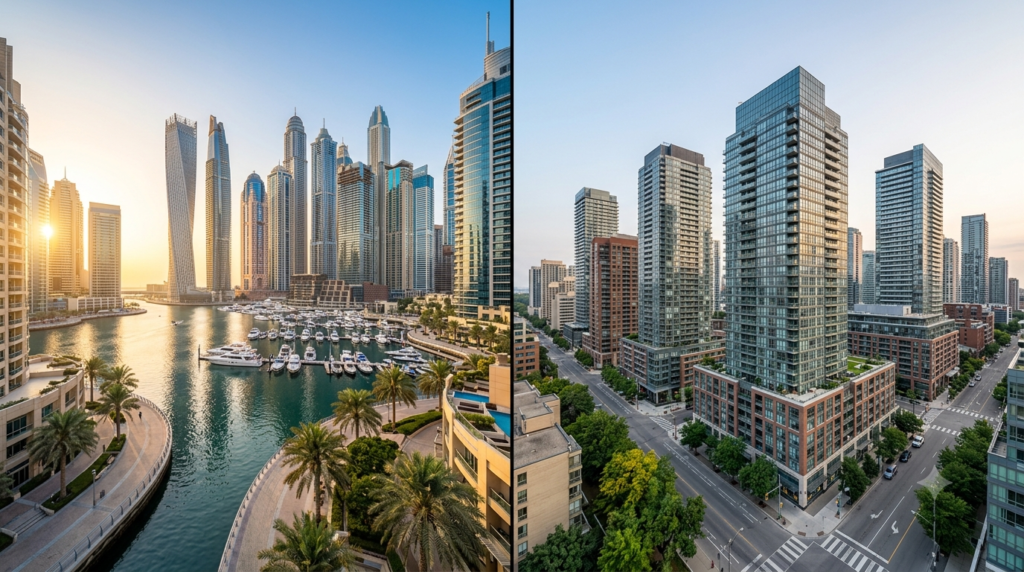
Dubai vs Toronto property investment comes down to one core trade-off: income now versus stability over decades. Dubai delivers higher cash flow, zero local tax, and a lower entry price. Toronto offers regulatory familiarity, currency simplicity, and long-term capital preservation.
This guide breaks the comparison down with real 2026 numbers. We compare entry prices, rental yields, taxes, foreign buyer rules, and capital growth. We also cover what each market means for a Canadian investor’s CRA position.
How Do Entry Prices Compare?
Entry price shapes every other metric. It determines your yield percentage, your financing cost, and your maximum exposure.
The table below sets out current entry prices for both markets by property type, using Q1 2026 data.
| Property type | Dubai entry (AED) | Dubai approx. (CAD) | Toronto entry (CAD) |
| Studio | From 475,000 | From 178,000 | From 570,000 |
| 1-bedroom | From 800,000 | From 300,000 | From 600,000 |
| 2-bedroom | From 1,200,000 | From 450,000 | From 850,000 |
| 3-bedroom | From 1,500,000 | From 562,000 | From 1,000,000 |
| Villa/house | From 1,800,000 | From 675,000 | From 1,500,000 |
Dubai offers a meaningful entry advantage at every tier. A Canadian investor can buy a two-bedroom in Dubai for roughly half the Toronto equivalent.
Dubai Pricing
Dubai’s market-wide average apartment price reached AED 1,916 per square foot in Q1 2026, per Dubai Land Department data. That is an 18 percent year-on-year rise. Prime locations like Palm Jumeirah average AED 3,750 per square foot, while mid-market areas like JVC sit near AED 1,473.
- Entry-level studios in JVC and Dubai South start below AED 500,000.
- Downtown Dubai and Dubai Marina apartments begin near AED 1.2 million.
- Off-plan units often carry payment plans of 40 percent during construction.
- The citywide average transaction value sits around AED 1.55 million.
Dubai gives Canadians more choice at every budget tier. That flexibility changes what diversification looks like for a foreign buyer.
Toronto Pricing
Toronto’s median condo sold price is CAD 590,000 at roughly CAD 766 per square foot, per CondoGo July 2026 data. The average home across all types sits near CAD 1.1 million. Price-to-income ratios hit 11.20 versus Dubai’s 6.87 according to Numbeo.
- Central Toronto condos start near CAD 570,000 for a studio.
- Single-family homes in the GTA routinely exceed CAD 1.5 million.
- RBC notes Toronto affordability cost equals roughly 65.2 percent of income.
- Condo inventory has risen to 5.3 months of supply, the highest in years.
Toronto demands significant capital just to enter at the bottom of the market. That threshold blocks many Canadian investors from building a multi-property portfolio.
Transaction Cost Gap
Both markets carry purchase costs on top of the headline price. The structure differs sharply.
- Dubai: 4 percent DLD transfer fee, 2 percent agency commission, minor admin fees totalling near 7 percent.
- Toronto: land transfer tax of 1.5 to 2.5 percent, plus the 25 percent Ontario Non-Resident Speculation Tax for foreign buyers.
- Canadian citizens avoid the NRST but still face stacked transfer costs.
- Foreign non-Canadian buyers in Toronto also face the federal residential purchase ban extended through January 2027.
Transaction costs alone can make Dubai vs Toronto property investment the easier decision. Now compare what each market does to your returns.
Entry prices and purchase costs are only part of the investment picture. Understanding these differences provides a stronger foundation for comparing long-term returns and overall investment value between Dubai and Toronto.

What Rental Yields Can You Expect?
Yield is the clearest head-to-head metric. It tells you how long before your rental income recovers your capital.
Dubai Gross Yields
Dubai consistently outperforms most global markets on gross rental yield. Numbeo’s 2026 comparison data shows Dubai city-centre gross yields at 7.35 percent and 8.99 percent outside the centre. DLD-registered data shows 1-bedroom apartments earning AED 60,000 to AED 98,000 in annual rent.
- JVC delivers 7 to 9 percent gross, the most consistent mid-market performer.
- Business Bay achieves 5.5 to 7.6 percent with strong CBD tenant demand.
- Dubai Marina earns 6 to 8 percent with high short-term rental appeal.
- Downtown Dubai sits at 4 to 6 percent, reflecting its premium price point.
Net yields after service charges and management fees run 1.5 to 2.5 percentage points below gross. Even at net, Dubai comfortably outperforms Toronto’s gross figure. Explore Dubai investment properties to see current yield benchmarks by area.
Toronto Gross Yields
Toronto’s rental picture weakened through early 2026. Global Property Guide data puts Toronto gross yields at 6.27 percent in 2026 — but this figure includes purpose-built rentals. The relevant comparison for condo investors is lower.
- A Toronto 1-bedroom renting for CAD 2,201 monthly on a CAD 600,000 unit yields roughly 4.4 percent gross.
- Toronto asking rents fell 7.9 percent year-on-year to CAD 2,482 in February 2026.
- TRREB reported GTA condo rental transactions down 16 percent in Q4 2025.
- Ontario rent control caps annual increases at 2.5 percent for pre-2018 buildings.
After municipal property tax, income tax on rent, and occasional vacancy, Toronto net yields for condo investors can compress toward 2.5 to 3 percent. That gap makes dubai vs toronto property investment a strong case for income-focused buyers.
After-Tax Yield Difference
This is the number that matters most. Properties in Dubai for Canadian investors earn rental income that is untaxed locally. Canada then taxes that income at your marginal rate.
- A 7 percent Dubai yield at a 40 percent Canadian marginal rate nets roughly 4.2 percent after Canadian tax.
- A 4 percent Toronto yield at the same rate nets roughly 2.4 percent after all taxes.
- The net gap is still nearly 2 full percentage points in Dubai’s favour.
- Short-term rentals in Dubai can push gross yields toward 10 percent in prime areas.
Tax is the silent variable that most comparison articles ignore. Model both markets net of all taxes before making any capital allocation decision.
Rental yield provides a clear measure of income potential, but it is only one part of investment performance. Capital growth is equally important when comparing the long-term value of Dubai and Toronto property markets.
How Different Are The Tax Rules?
Tax treatment defines long-term performance far more than headline prices.
Dubai Tax Position
Dubai charges no property, rental, or capital gains tax at the residential level. The 4 percent DLD transfer fee is a one-time purchase cost, not an annual obligation.
- Zero annual property tax on any residential unit.
- Zero tax on rental income earned inside the UAE.
- Zero capital gains tax when you sell.
- A 9 percent corporate tax applies only to businesses, not individual property owners.
This structure means your gross yield is your pre-CRA yield. You keep every dirham the tenant pays before Canadian obligations apply. Our Dubai property tax for Canadians guide covers the CRA side in detail.
Toronto Tax Burden
Toronto stacks multiple layers of tax on property investors. Each layer erodes net return.
- Municipal property tax of roughly 0.6 to 0.7 percent of assessed value annually.
- Rental income taxed at your full Canadian marginal rate, which can reach 53.5 percent in Ontario.
- Capital gains taxed at a 50 percent inclusion rate in 2026, at your marginal rate.
- Ontario land transfer tax of 1.5 to 2.5 percent at purchase, plus Toronto’s own municipal land transfer tax.
For a non-Canadian buying in Toronto, the Ontario NRST adds 25 percent on top. The federal ban on non-Canadian residential purchases extends through January 2027, making most Toronto residential property off-limits for foreign buyers entirely.
CRA Position For Canadians
Whether you buy in Dubai or Toronto, Canada taxes your worldwide income. The key difference is the foreign tax credit.
- A Toronto rental income generates Canadian tax, with no offsetting foreign credit.
- A Dubai rental generates the same Canadian tax, also with no foreign credit because the UAE charges nothing.
- Dubai’s advantage is not tax elimination. It is higher pre-tax income to be taxed.
- See our guide on whether Canadians can buy property in Dubai for the full ownership structure breakdown.
The net outcome still favours Dubai for income-focused investors. Higher gross yield beats lower gross yield even at the same effective tax rate. Now compare what each market does for your capital over time.
Tax rules have a direct impact on your overall investment returns, but they are only part of the equation. The next step is comparing each market’s long-term capital growth potential to understand where your investment could appreciate most over time.
Which Market Grows Capital Faster?
Capital appreciation is where Toronto has historically argued its case. The 2026 data complicates that narrative.
Dubai Appreciation Trend
Dubai’s market posted 270,000 transactions in 2025 worth Dh917 billion, per Dubai Land Department records. Q1 2026 added Dh252 billion, a 31 percent year-on-year jump in transaction value. ValuStrat forecasts 10 percent citywide residential capital value growth in 2026, with villas expected to rise 17.7 percent.
- Average price per square foot rose 18 percent year-on-year to AED 1,976 in January 2026.
- Off-plan now represents 73 to 78 percent of transaction value, reflecting strong future pipeline demand.
- Dubai added 129,600 new investors in 2025, a 23 percent year-on-year rise.
- Foreign investment rose 26 percent to AED 148.35 billion in Q1 2026.
These are not speculative projections. They are recorded transaction figures from the DLD. Explore current off-plan properties in Dubai to see what is available in the pipeline.
Toronto Appreciation Trend
Toronto’s capital growth story is undergoing a reset in 2026. Nesto’s July 2026 Toronto market report notes that condo transactions sit roughly 34 percent below pre-pandemic levels. Royal LePage flags Toronto as the only major Canadian market it expects to see further price declines in Q4 2026.
- Condo inventory stands at 5.3 months of supply, favouring buyers over sellers.
- The GTA benchmark price rose month-on-month for the first time in over a year in June 2026, a modest recovery.
- Toronto affordability improvement metric: 65.2 percent of income required to own.
- Average asking rent fell 7.9 percent year-on-year in February 2026 before recovering slightly.
Toronto’s long-term appreciation case remains intact over a 20-year horizon. Over a 3 to 5-year investment window, Dubai’s current trajectory is stronger. Browse Dubai pre-construction properties for pipeline access to that appreciation.
Side-By-Side Market Summary
The table below shows the key metrics for both markets in one view.
| Metric | Dubai (2026) | Toronto (2026) |
| Average price per sqm | AED 20,000 (~CAD 7,500) | CAD 8,250 (central condos) |
| Gross rental yield | 6 to 9 percent | 3.4 to 4.4 percent (condos) |
| Annual property tax | None | 0.6 to 0.7 percent of value |
| Foreign buyer restriction | None in freehold zones | 25% NRST plus federal ban |
| YoY price growth (apartments) | Plus 18 percent | Flat to minus 2 percent |
| Golden Visa eligibility | AED 2M qualifies | Not applicable |
This table covers the mechanics. The right choice still depends on your timeline, tax situation, and goals.
Growth trends provide valuable insight into future returns, but they should not be viewed in isolation. The final investment decision depends on balancing appreciation, rental income, costs, and your long-term financial objectives.
Which Investor Profile Fits Each Market?
Not every investor profile suits Dubai vs Toronto property investment equally. The right market depends on what you are actually trying to achieve.
Income-Focused Buyers
Income-focused investors want strong monthly cash flow and rapid capital recovery.
- Dubai delivers 6 to 9 percent gross with zero local tax on every dirham earned.
- Toronto delivers 3.4 to 4.4 percent gross before stacked municipal and federal taxes.
- Dubai’s after-Canadian-tax net yield still beats Toronto’s gross yield in most scenarios.
- Short-term rental operators in Dubai Marina and Downtown can exceed 10 percent gross.
If monthly cash flow is your primary goal, Dubai wins this category outright. The Dubai Property Expo Canada event connects buyers directly with developers offering current payment plans.
Long-Term Capital Holders
Some investors prioritise decades of compounding over near-term income.
- Toronto’s 20-year price appreciation record is among the strongest in North America.
- Dubai’s 10-year record also shows strong growth but with two notable correction cycles.
- Toronto assets benefit from Canadian dollar denomination and domestic financing familiarity.
- Dubai assets benefit from the AED-USD peg, which protects against CAD depreciation.
Neither market is inherently better for long-term holders. The currency exposure and your tax residency timeline matter more than the market itself.
Visa-Seeking Investors
Some Canadian investors want residency optionality alongside their property return.
- A Dubai purchase of AED 2 million qualifies for the 10-year UAE Golden Visa.
- A purchase of AED 750,000 qualifies for a 2-year investor visa.
- Toronto offers no residency pathway through property investment.
- Our guide to the Dubai Golden Visa Canada route covers every qualifying step.
For Canadians who want a second residency base without giving up their Canadian passport, Dubai is the only option between these two markets.
Every investor has different priorities, and no single market fits every strategy. Comparing your income goals, growth expectations, and long-term plans will help you choose the market that aligns best with your objectives.
Ready To Compare With Real Numbers?
Dubai vs Toronto property investment is not a close contest on income return. Dubai delivers nearly double the gross yield, zero local tax, no foreign buyer barriers, and a Golden Visa path for investors above AED 2 million. Toronto offers familiarity, sterling long-term appreciation credentials, and a CAD-denominated asset.
The honest answer is that most income-focused Canadian investors are better served by Dubai in 2026. Toronto makes most sense if you hold Canadian citizenship, plan a 15-plus year hold, and prioritise domestic regulatory protection over returns.
Register free with Dubai Property Expo Canada to meet verified developers and model real yields against your budget. Make your 2026 allocation decision with actual numbers, not headlines.
Frequently Asked Questions
Is Dubai property a better investment than Toronto in 2026?
For income-focused investors, Dubai delivers stronger returns in 2026. Gross yields of 6 to 9 percent compare favourably to Toronto’s 3.4 to 4.4 percent, and Dubai charges zero local property or rental tax. Toronto offers stronger long-term capital preservation credentials over a 20-year horizon. Your investment timeline and tax position should drive the decision.
Can Canadians buy property in both Dubai and Toronto?
Canadian citizens can buy in both markets freely. In Toronto, the foreign buyer restrictions apply only to non-Canadians. In Dubai, 100 percent foreign freehold ownership is permitted in designated zones, and there are no nationality restrictions. Most Canadians find the Dubai process faster and less document-heavy than navigating Ontario’s land transfer system.
What is the price difference between Dubai and Toronto property?
A Dubai 1-bedroom starts near AED 800,000, roughly CAD 300,000 at current rates. A comparable Toronto 1-bedroom starts near CAD 600,000. Dubai’s price advantage is largest at the studio and 1-bedroom tier. At the villa level, Toronto’s detached homes and Dubai’s freehold villas reach similar price points in Canadian dollars.
Do I pay tax in Canada on Dubai rental income?
Yes. Canada taxes residents on worldwide income regardless of where it is earned. Dubai charges no local tax, so there is no foreign tax credit to offset your Canadian liability. You report rent on Form T776 and foreign assets on Form T1135 if the cost exceeds CAD 100,000. A cross-border accountant should model your net yield before you purchase.
Does buying Dubai property give you Canadian residency?
No. A Dubai property purchase gives you access to the UAE Golden Visa, not Canadian residency. The Golden Visa grants 10-year renewable UAE residency for purchases of AED 2 million or more. It does not affect your Canadian tax residency status, which the CRA determines based on your residential ties to Canada, not your foreign visa holdings.