Quick Answer:
The T1135 threshold is CAD 100,000 in foreign property cost — triggered at any point during the tax year
-
Late filing penalty is CAD 25 per day, minimum CAD 100, maximum CAD 2,500 even with no tax owing
-
Gross negligence or CRA demand raises the T1135 foreign property penalty cra to CAD 500 to CAD 1,000 per month
-
Dubai investment properties must be reported on T1135 from the year of first deposit payment, not handover
-
After 24 months of sustained non-compliance, the penalty reaches 5% of the cost of the foreign property
Thousands of Canadian investors who own foreign property are unknowingly accumulating CRA penalties every single year. They reported their Dubai rental income correctly. They paid their Canadian taxes on time. But they missed one form, the T1135 Foreign Income Verification Statement, and CRA assessed penalties anyway, without any additional tax owing.
The T1135 foreign property penalty card rules are not complicated once you understand them. The form itself is not a tax bill. It is a disclosure requirement. But the penalties for missing it or filing it late are real, tiered, and, in cases of sustained non-compliance, can reach 5% of the total cost of your foreign assets. For a Canadian who owns a CAD 800,000 Dubai apartment, that exposure reaches CAD 40,000 in penalties on top of whatever other obligations exist.
This guide covers every aspect of T1135 foreign property penalty cra obligations for Canadian property investors in 2026: what the form is, who must file, the full penalty structure, how Dubai property specifically is treated, the two-tier Part A and Part B reporting system, and exactly what to do if you have missed filings you need to fix.
What Is the T1135 Form?
The T1135 Foreign Income Verification Statement is a Canada Revenue Agency disclosure form that has nothing to do with how much tax you owe. It exists purely to tell the CRA what foreign assets you hold. But as thousands of Canadian investors discover each year, the t1135 foreign property penalty CRA rules do not care whether you owe any additional tax. Missing the form triggers penalties automatically.
T1135 Explained
Form T1135, Foreign Income Verification Statement, must be filed by Canadian resident individuals, corporations, and certain trusts that, at any time during the year, own specified foreign property costing more than CAD 100,000.
The key word in that definition is cost. The threshold is based on the original cost amount of the property, also called the Adjusted Cost Base or ACB, not the current fair market value. A Canadian who purchased a Dubai apartment for CAD 120,000 in 2023 must file T1135 even if the apartment is now worth CAD 160,000. Equally, a Canadian whose portfolio has grown above the threshold must continue filing even if the current value has declined below it.
The T1135 is not a tax assessment. Filing it correctly does not trigger any additional tax obligation beyond what already applies to your foreign rental income on your T1 return. The form simply discloses what you hold, where it is, and what income it generated. The CRA uses this information to verify that Canadian residents are correctly reporting their worldwide income.
Who Must File
The t1135 foreign property penalty card obligation applies broadly to Canadian tax residents who hold foreign assets above the cost threshold. This includes a wider range of people than most Canadians assume.
Who must file Form T1135 in 2026:
-
Canadian resident individuals who hold specified foreign property with a total cost exceeding CAD 100,000 at any point in the year
-
Canadian corporations holding specified foreign property above the threshold
-
Certain Canadian trusts with qualifying foreign holdings
-
Partnerships holding more than CAD 100,000 of specified foreign property
-
Joint property owners where each owner's proportionate share exceeds CAD 100,000
The filing requirement applies even if you sold the foreign property before December 31 of the tax year. If the total cost exceeded CAD 100,000 at any time during the year, you are still required to file T1135, even if you sold some or all of your specified foreign property before the end of the year.
This catches many Canadian Dubai investors off guard. If you sold your Dubai apartment in October and your cost was above CAD 100,000, you still must file T1135 for that year. The obligation does not disappear on sale.
Filing Deadline 2026
The T1135 filing deadline aligns with the annual income tax return deadline. Missing either deadline triggers penalties, but the T1135 penalties apply independently of any tax balance.
|
Taxpayer Type |
T1135 Filing Deadline |
Tax Owing Due Date |
|
Individual (salaried) |
April 30, 2027 (for 2026 year) |
April 30, 2027 |
|
Self-employed individual |
June 15, 2027 (for the 2026 year) |
April 30, 2027 |
|
Corporation |
6 months after fiscal year end |
3 months after fiscal year end |
|
Trust |
90 days after trust year end |
90 days after trust year end |
The T1135 can be filed electronically through NETFILE or EFILE for individuals, or by paper submission. Filing electronically is strongly recommended as it creates a timestamped digital receipt that proves timely filing in any future CRA dispute.
For Canadians investing in Dubai property through the Dubai Property Expo Canada, the T1135 obligation begins in the tax year of your first deposit payment, not on handover.
T1135 Penalty CRA Breakdown
The T1135 foreign property penalty CRA structure is tiered by the severity and duration of the non-compliance. Understanding each tier helps Canadian Dubai investors quantify their exposure and take corrective action before the penalties compound.

Late Filing Penalty
The base T1135 foreign property penalty CRA for ordinary late filing is CAD 25 per day, with a minimum of CAD 100 and a hard maximum of CAD 2,500 per year of non-filing. This penalty applies even when the income was fully reported, all Canadian tax was paid on time, and the failure to file was entirely unintentional.
Key facts about the base late filing penalty:
-
CAD 25 per day from the first day past the deadline
-
Minimum penalty assessed: CAD 100
-
Maximum penalty per unfiled year: CAD 2,500
-
Penalty applies even with zero additional tax owing
-
Interest on the penalty amount applies from the date of assessment
-
Multiple unfiled years mean multiple separate CAD 2,500 penalties accumulating simultaneously
Real case illustration: a Canadian investor missed T1135 for one year while holding US shares above the threshold for two months. All income was declared. CRA assessed CAD 2,500 plus interest in arrears. A taxpayer relief application was denied. A second appeal on financial hardship grounds was in progress. The CRA enforces even innocent mistakes.
Gross Negligence Penalty
When the CRA determines that the failure to file T1135 involved gross negligence or deliberate disregard for the requirement, the T1135 foreign property penalty CRA escalates dramatically.
Gross negligence penalties apply in situations including:
-
Repeated failures to file after being made aware of the requirement
-
Deliberately structuring foreign holdings to avoid the threshold
-
Providing inaccurate information about foreign assets when filing
-
Being advised by a tax professional of the obligation and still not filing
-
Failure to file after CRA has previously raised the matter in correspondence
The gross negligence determination is subjective. CRA auditors exercise discretion in classification. However, once classified as gross negligence, the monthly penalty structure applies retroactively from the original filing deadline.
24-Month Rule
The 24-month rule is the most severe tier of the T1135 foreign property penalty CRA structure and the one most likely to catch long-term Dubai property investors who have been unaware of the T1135 requirement.
|
Non-Compliance Period |
Penalty Structure |
Maximum |
|
Day 1 to 100 (standard late) |
CAD 25 per day |
CAD 2,500 per year |
|
Months 1-24 (gross negligence) |
CAD 500 per month |
CAD 12,000 |
|
Post-CRA demand to file |
CAD 1,000 per month |
CAD 24,000 |
|
Beyond 24 months sustained |
5% of foreign property cost |
No fixed cap |
For a Canadian investor with a Dubai portfolio valued at CAD 800,000 (cost basis) who has not filed T1135 for three years, the 5% penalty exposure is CAD 40,000 per unfiled year where the 24-month threshold has been exceeded. This is entirely separate from any income tax owing on the rental income itself.
Additionally, each year T1135 was late opens a three-year extended reassessment period, meaning the CRA retains the right to audit not just the T1135 but the entire tax return for every year with a missed filing.
Penalties for non-compliance in 2026 are tiered: CAD 25 per day to a maximum of CAD 2,500 for basic late filing, CAD 500 per month to a maximum of CAD 12,000 for intentional non-compliance, CAD 1,000 per month to a maximum of CAD 24,000 after a CRA demand to file, and as high as 5% of the cost of the foreign assets for sustained non-compliance beyond 24 months.
These penalties compound over multiple years of non-filing. A Canadian who missed T1135 filings for four years on a CAD 400,000 Dubai property faces a very different exposure than someone who filed one day late on a single return.
What Property Must Be Reported
Understanding exactly what qualifies as specified foreign property for T1135 purposes removes the most common source of confusion for Canadian Dubai investors. Not every foreign asset you hold triggers the reporting obligation, and some Dubai property scenarios are exempt.
Dubai Property Rules
Dubai investment properties, meaning properties held for rental income or capital appreciation, are specified foreign property that must be reported on T1135 once the cost threshold is exceeded.

This applies to Canadian owners of Dubai property in the following scenarios:
-
Off-plan Dubai apartment generating no income yet because it has not been handed over
-
Ready Dubai property generating active rental income managed remotely from Canada
-
Dubai villa held for long-term capital appreciation without current tenants
-
Multiple Dubai properties collectively exceeding the CAD 100,000 cost threshold even if individually below it
-
Dubai property held jointly with a non-resident spouse where the Canadian resident's share exceeds CAD 100,000
The critical point for off-plan investors: the T1135 obligation begins in the year your first payment is made. If you pay a CAD 30,000 reservation deposit in November 2026 on a CAD 300,000 Dubai apartment, your cost amount is CAD 30,000 for 2026. If that is your only foreign property, you are below the threshold in 2026. But as you make further payments in 2027 and cross CAD 100,000, the T1135 obligation activates for that year.
For guidance on the full buying process for off-plan Dubai property from Canada, see how to buy pre-construction property in Dubai from Canada.
Exempt Property Types
Not all foreign assets need to be reported on a T1135. Personal-use property such as a vacation home outside Canada that is used mainly for personal reasons is exempt from T1135 reporting obligations.
Property types that are exempt from T1135 reporting include:
-
A Dubai apartment used exclusively for personal vacation purposes and never rented out
-
Foreign assets held inside Canadian registered accounts: RRSP, RRIF, TFSA, RESP, RDSP, and FHSA
-
Shares of Canadian mutual funds or ETFs that hold foreign securities
-
Personal-use assets abroad including jewelry, artwork, vehicles, and boats
-
Dubai property inherited where the estate is still being settled and the Canadian beneficiary has not received title
The personal-use exemption has a critical limitation. If your Dubai apartment is used personally for some months and rented out for other months, the personal-use exemption does not apply. A mixed-use Dubai property that generates any rental income is a specified foreign property and must be reported.
Off-Plan Deposits
Off-plan deposits paid to RERA-registered escrow accounts for Dubai property purchases are specified foreign property from the moment they are paid. This is one of the most consistently misunderstood aspects of the T1135 foreign property penalty CRA rules for Canadian Dubai investors.
How off-plan deposits accumulate toward the T1135 threshold:
-
Each payment made to the developer escrow account increases your cost amount
-
When the cumulative cost of all specified foreign property crosses CAD 100,000, T1135 filing becomes mandatory for that tax year
-
The CAD cost is calculated at the Bank of Canada spot rate on the date each payment was made
-
Property not yet handed over and not generating income is still specified foreign property once registered in your name or with DLD under your Oqood
For a full overview of Dubai off-plan pricing and what payments are typically required, see our guide to how much properties in Dubai cost for Canadian buyers.
T1135 Part A vs Part B
The T1135 form uses a two-tier reporting structure that determines how much detail you must provide based on the total cost of your foreign holdings. Understanding which part applies to your situation determines both the complexity of the filing and the consequences of making errors.
Part A Reporting
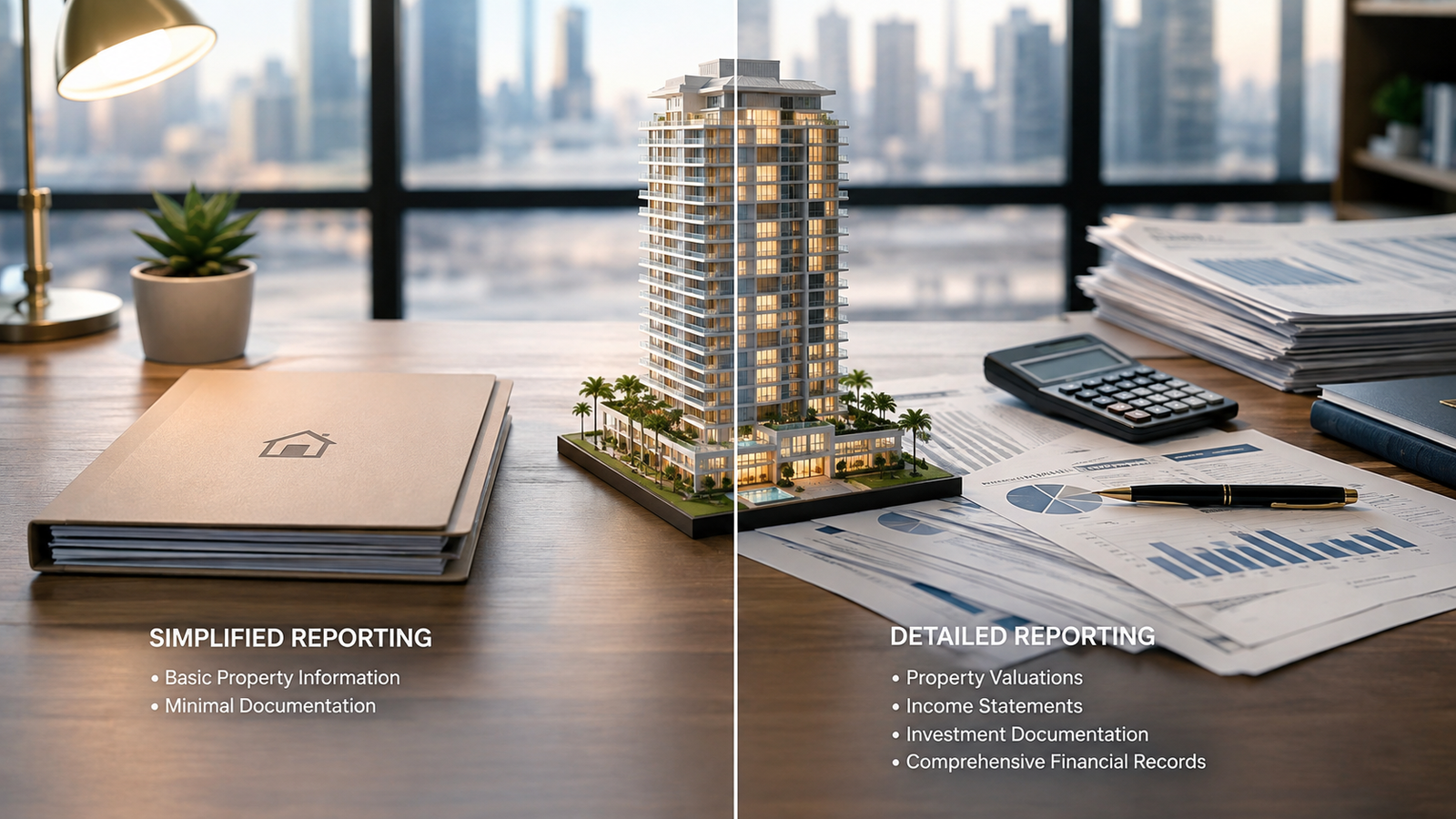
Part A is a simplified reporting method for taxpayers who held specified foreign property with a total cost of more than CAD 100,000 but less than CAD 250,000 throughout the year. This reporting method allows taxpayers to check the box for each type of property they held during the year rather than providing the details of each property.
Part A simplified reporting for Canadian Dubai investors covers:
-
Tick-box confirmation of property type categories held during the year
-
Country of holding (United Arab Emirates for Dubai property)
-
Confirmation that all income from the foreign property was reported on the T1 return
-
No requirement to list individual property addresses, values, or income figures
Part A is significantly less burdensome than Part B and is appropriate for most Canadian first-time Dubai investors who hold a single property below the CAD 250,000 cost threshold.
Part B Reporting
Part B applies when the total cost of your specified foreign property reached CAD 250,000 or more at any point during the tax year. Part B requires detailed reporting for each individual property held.
Under Part B, Canadian Dubai investors must provide:
-
Name and country of each foreign property
-
Maximum fair market value during the year
-
Fair market value at December 31 of the tax year
-
Cost amount of the property
-
Income generated (rent received) during the year
-
Capital gain or loss on any property disposed of during the year
For Canadian investors with a CAD 800,000 Dubai apartment, Part B applies and requires the full DLD-registered value, annual rental income received, and year-end property valuation. All amounts are converted to Canadian dollars at Bank of Canada spot rates.
How to File
Form T1135 can be filed electronically through NETFILE or EFILE for individuals for the 2017 and later tax years. Electronic filing is strongly recommended because it generates a confirmation number that serves as proof of timely submission.
Step-by-step T1135 filing process for Canadian Dubai investors:
-
Step 1: Determine the total cost amount of all specified foreign property in CAD at the highest point in the year
-
Step 2: Confirm whether Part A or Part B applies based on the CAD 100,000 to CAD 249,999 or CAD 250,000+ thresholds
-
Step 3: Convert all AED amounts to CAD at the Bank of Canada spot rate on each payment date
-
Step 4: Complete the appropriate Part using your tax filing software or by paper
-
Step 5: File electronically with your T1 return before April 30 (or June 15 if self-employed)
-
Step 6: Retain all supporting documents including DLD certificates, payment receipts, and rental income statements for a minimum of 6 years
For context on Dubai property that Canadian investors are reporting on T1135, see our overview of dubai investment properties.
How to Fix Missed T1135
If you have missed one or more T1135 filings as a Canadian Dubai property investor, the worst action you can take is to do nothing. The T1135 foreign property penalty and CRA penalties compound every year the filing remains outstanding, and the extended reassessment periods mean CRA exposure grows with each missed year.
Voluntary Disclosure Program
The CRA's Voluntary Disclosures Program allows Canadian taxpayers to come forward with unfiled or incorrectly filed T1135 returns before CRA contacts them, in exchange for partial or full penalty relief.
|
VDP Condition |
Benefit |
|
Filed before CRA contact |
Penalty relief considered; interest typically still applies |
|
All unfiled years disclosed at once |
Full relief considered for years voluntarily disclosed |
|
Income correctly reported in original T1 |
Strongest case for penalty relief |
|
Late-filed T1135 with no other non-compliance |
High probability of penalty reduction or waiver |
The VDP has strict eligibility requirements. You cannot apply if CRA has already contacted you about the missing T1135. You must disclose all years simultaneously, not selectively. And the disclosure must be voluntary and complete.
For Canadian Dubai investors with multiple years of missed T1135 filings, engaging a Canadian cross-border tax advisor or VDP specialist before making any contact with CRA is strongly recommended.
Taxpayer Relief Options
For Canadians who cannot access VDP because CRA has already identified the non-compliance, the Taxpayer Relief Program provides a separate mechanism to request waiver or cancellation of penalties based on specific circumstances.
Grounds for taxpayer relief consideration include:
-
Extraordinary circumstances beyond the taxpayer's control such as serious illness or natural disaster
-
Actions of the CRA that caused or contributed to the late filing
-
Financial hardship caused by the penalties relative to the taxpayer's means
-
First-time non-compliance with an otherwise clean compliance history
The taxpayer relief application is submitted on Form RC4288. As illustrated by the case referenced earlier, relief is not guaranteed, and denial is common for straightforward late-filing situations. However, sustained engagement through professional representation improves outcomes compared to self-represented applications.
Prevention Strategy
The most effective approach to avoiding T1135 foreign property penalty CRA exposure is establishing the reporting infrastructure in the same year you make your first Dubai property payment.
Practical prevention steps for Canadian Dubai investors:
-
Notify your Canadian accountant of the Dubai purchase in the same year you pay the reservation deposit
-
Set up a CAD-denominated record of every AED payment made, converted at the Bank of Canada rate on each payment date
-
Confirm with your accountant whether Part A or Part B applies based on your projected total cost in that year
-
Schedule T1135 filing as a standing annual task alongside your T1 return preparation
-
Do not wait for handover — the obligation begins with the first deposit
-
Keep all DLD certificates, RERA escrow receipts, and payment confirmations for a minimum of six years
For Canadian investors still exploring Dubai property options before the obligation begins, see our complete guide to off plan properties in Dubai.
Two formal relief mechanisms exist: the Voluntary Disclosures Program for proactive self-correction, and the Taxpayer Relief application for penalty reduction after the fact. Both are significantly more effective the earlier they are pursued.
Ready to Invest Without Risk?
The T1135 foreign property penalty CRA rules are not a reason to avoid Dubai property investment. They are a reason to approach it with proper professional support from day one. The form itself is straightforward, the penalties are entirely avoidable with timely filing, and the reporting obligation does not create any additional UAE tax liability on your investment. It is a disclosure requirement that takes your accountant one filing session per year to satisfy correctly.
For Canadian investors who have missed filings, the situation is recoverable through the VDP before CRA makes contact, and through formal taxpayer relief applications afterward. The key is to act immediately rather than allowing penalties to compound across multiple years. Every year of delay increases the exposure, extends the reassessment period, and narrows the relief options available.
Register for free at dubaipropertyexpocanada.com and invest in Dubai property with full confidence in your Canadian compliance position.
Frequently Asked Questions
What is the T1135 penalty for late filing with CRA in 2026?
The standard T1135 foreign property penalty CRA for late filing is CAD 25 per day, with a minimum penalty of CAD 100 and a maximum of CAD 2,500 per year of non-filing. This penalty applies even when no additional Canadian tax is owing and the failure to file was entirely unintentional. Gross negligence or wilful non-compliance escalates the penalty to CAD 500 per month up to a maximum of CAD 12,000. After a CRA demand to file, the penalty rises to CAD 1,000 per month up to CAD 24,000. After 24 months of sustained non-compliance, the penalty reaches 5% of the total cost of the foreign property with no fixed cap.
Does a Dubai investment property need to be reported on T1135?
Yes. A Dubai property purchased as an investment, including off-plan properties that have not yet been handed over, is specified foreign property that must be reported on T1135 once your cumulative cost amount across all foreign holdings exceeds CAD 100,000 at any point in the year. The obligation begins in the tax year your first deposit payment is made, not at handover. A Dubai property used exclusively for personal vacation purposes and never rented out is exempt as personal-use property.
When does the T1135 filing obligation start for Dubai off-plan buyers?
The T1135 obligation begins in the tax year you first make payments that bring your total specified foreign property cost above CAD 100,000. For off-plan Dubai purchases, each deposit and installment payment increases your cumulative cost amount. The AED amounts are converted to CAD at the Bank of Canada spot rate on the date of each payment. Canadian investors on standard developer payment plans may cross the threshold midway through the construction period, triggering T1135 for that year without any income being generated yet.
What is the difference between T1135 Part A and Part B?
Part A is the simplified reporting method for Canadian investors whose total specified foreign property cost was between CAD 100,000 and CAD 249,999 throughout the entire year. Part A requires only tick-box confirmation of property categories held. Part B is the detailed reporting method that applies when the total cost reaches CAD 250,000 or more at any point during the year. Part B requires full details of each property including maximum fair market value, year-end value, income generated, and gain or loss on any disposals.
What should I do if I missed T1135 filings for my Dubai property in previous years?
If the CRA has not yet contacted you about the missed filings, the CRA's Voluntary Disclosures Program is the most effective option. You must disclose all unfiled years simultaneously, and all foreign income must have been reported on your T1 returns. VDP can result in partial or full penalty relief, with interest typically still applying. If the CRA has already identified the non-compliance, a Taxpayer Relief application on Form RC4288 is the available mechanism. Engage a Canadian cross-border tax advisor or VDP specialist before making any contact with the CRA, as professional representation significantly improves outcomes.